
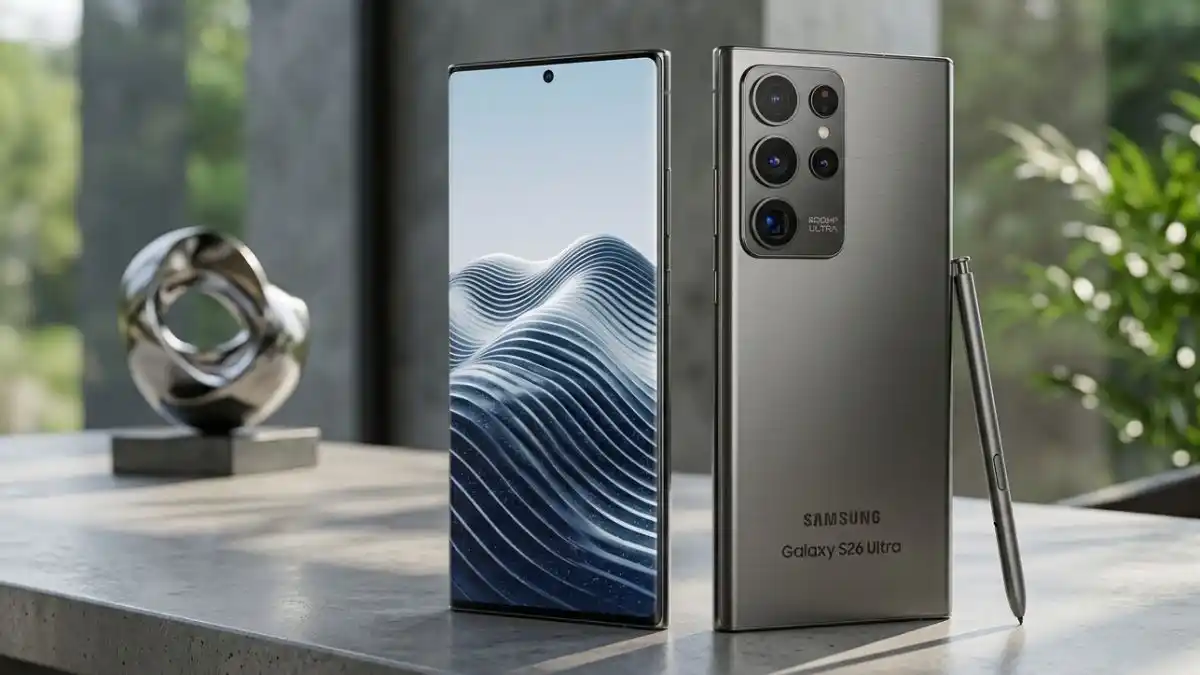
The Samsung Galaxy S26 Ultra was announced on February 25, 2026 at Galaxy Unpacked in San Francisco and available for sale globally on March 11, 2026. S26 Ultra Samsung’s flagship phone for 2026 and sits at the top of the Galaxy S26 lineup above the standard S26 and the S26+. The S26 Ultra starts at $1,299 (approximately ₹1,08,000) for the 256GB model.
Before start camera details, let’s check what has changed on the outside. The Galaxy S26 Ultra has a 6.9-inch Dynamic LTPO AMOLED 2X display with a 120Hz refresh rate and 2,600 nits peak brightness. The frame has switched from titanium back to aluminium a change that brings it in line with the S23 Ultra and reduces weight. The phone now has more rounded corners compared to the sharp edges of the S25 Ultra.
Samsung Galaxy S26 Ultra Camera
The Samsung Galaxy S26 Ultra uses a quad-camera system on the rear. 200MP primary wide-angle camera with a f/1.4 aperture, 50MP ultrawide camera, 10MP 3x telephoto with a f/2.0 aperture and 50MP periscope telephoto 5x optical zoom with a f/2.9 aperture
The most significant change from the S25 Ultra to the S26 Ultra is the aperture upgrade. The primary 200MP camera aperture has widened from f/1.7 to f/1.4 confirmed by Samsung’s official press release and Tech Advisor. The 5x telephoto aperture has also widened from f/3.4 to f/2.9.
A wider aperture means the camera lets in more light. The 47 percent more light this details comes directly from Samsung’s official Global Newsroom post confirmed for the 200MP wide camera compared to the S25 Ultra. The 5x telephoto captures 37 percent more light than the equivalent camera on the S25 Ultra.
Also Read:https://echodesknews.com/nothing-phone-4a-vs-oneplus-nord-5-camparison/
This means sharper photos in lower light, less noise in dim environments, and better background separation in portrait shots all without having to change any settings.
The Galaxy S26 Ultra also introduces the All Lens On Prism (ALoP) mechanism for its 5x telephoto camera replacing the traditional periscope lens design used in previous models. The ALoP mechanism is a new optical engineering approach that improves light transmission through the telephoto system.
The AI ISP Image Signal Processor has been extended to the front camera for the first time on the S26 Ultra. This means the same processing intelligence that was previously only applied to rear camera shots now works on selfies as well capturing fine details like individual hair strands and eyebrows while keeping natural skin tones, according to Samsung Newsroom.
On software, all Galaxy S26 models use Samsung’s ProVisual Engine for image processing. Features include Photo Assist with natural language prompts where you can type what you want changed in a photo and Galaxy AI processes the edit automatically.
The Galaxy S26 Ultra supports 8K video recording confirmed by GSMArena. This is the highest video resolution available on a smartphone. 8K footage captures an enormous amount of detail useful for filmmakers who need to crop in during post-production or deliver to 8K screens.
Also Read:https://echodesknews.com/vivo-x300-ultra-audio-upgrades/
For everyday video, the S26 Ultra supports. 4K at 30fps, 60fps, and 120fps on the rear cameras, 4K at 60fps on the front camera, 1080p at up to 240fps for slow motion and HDR10+ video on all rear cameras
The Super Steady mode is available for handheld video and uses electronic image stabilisation to smooth out walking and movement footage. Super Steady results may vary depending on editing method and shooting conditions confirmed by Samsung’s official footnotes.
The ProVisual Engine is active during video recording as well processing exposure, colour, and detail in real time across all cameras. This means the phone can maintain consistent colour and exposure even when switching between different zoom levels during a video.
Nightography
Nightography is Samsung’s brand name for its low-light photography and video technology. On the Galaxy S26 Ultra, Nightography has been upgraded with two specific improvements:
First — the wider f/1.4 aperture on the 200MP main camera. A wider aperture allows more light to reach the sensor. This directly improves low-light performance without any AI processing it is a hardware improvement. Samsung confirmed at Galaxy Unpacked 2026 that even a recreated San Francisco nightscape inside a dim exhibition hall appeared vivid and detailed in video captured with the S26 Ultra’s Nightography reported by Samsung Newsroom.
Second — the AI ISP applied to low-light processing. The AI ISP works in real time during Nightography captures analysing the scene, identifying faces and subjects, reducing noise, and enhancing detail simultaneously. The result is photos and videos that retain colour accuracy in dim conditions where previous phones would show heavy noise or loss of detail.
The Nightography improvements apply to both photos and videos confirmed by Samsung Newsroom. Video recorded in low light with Nightography enabled maintains consistent colour and detail across frames, which was a common complaint with previous generations where low-light video was noticeably noisy or flickery.
The wider f/2.9 aperture on the 5x telephoto also improves Nightography at zoom levels meaning you can shoot zoomed-in low-light shots with less noise than was possible on the S25 Ultra
Horizon Lock
Horizon Lock is a video stabilisation feature available on the Galaxy S26 Ultra within the Super Steady video stabilisation mode. It is confirmed by Wikipedia’s Galaxy S26 article as a feature within the Super Steady option.
Horizon Lock keeps the horizon level in the frame even when the phone is tilted or rotated during filming. This is different from standard video stabilisation which reduces shakiness because Horizon Lock specifically prevents the horizon line from tilting when you move your wrist or body while recording.
The feature works by using the phone’s gyroscope and the video processing engine together to calculate the horizon angle in real time and counter-rotate the frame digitally to keep it level.
One trade-off with Horizon Lock as with most electronic stabilisation features is a slight crop to the video frame. To stabilise and level the footage, the camera uses a smaller portion of the sensor, which means the effective field of view is slightly narrower when Horizon Lock is active.
6 thoughts on “Samsung Galaxy S26 Ultra Review — 200MP Camera, Video Capabilities, Nightography, and Horizon Lock”