
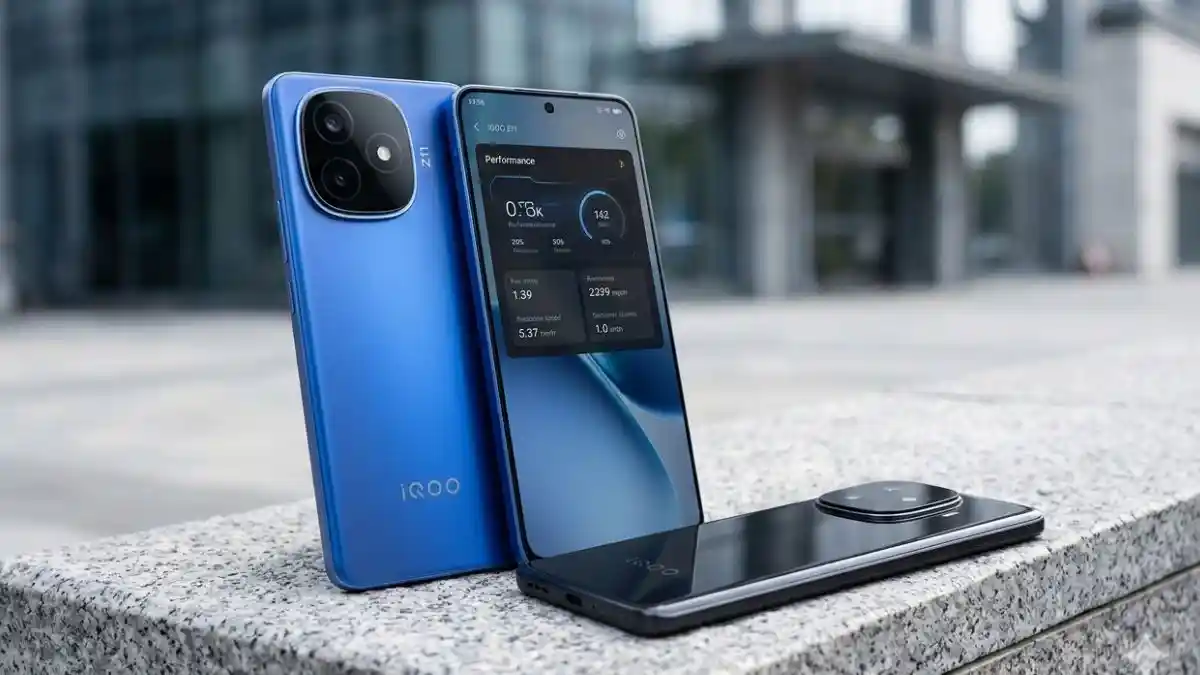
The iQOO Z11 has appeared on Geekbench for the first time. The listing was spotted on March 16, 2026 and reported by GizBot. The phone showed up under model number V2551A the internal identifier that iQOO uses during testing and certification before an official launch.
The Geekbench listing confirmed three things the iQOO Z11 chipset, the RAM amount, and the operating system. It also gave us the phone’s first benchmark scores. Combined with earlier certification leaks and official teasers from iQOO, we now have a reasonably complete picture of what the Z11 will offer before it officially launches.
The iQOO Z11 is different phone from the Z11x and the Z11 Turbo. The Z11x launched in India on March 12, 2026 at ₹18,999 with the Dimensity 7400 Turbo. The Z11 Turbo launched in China on January 15, 2026 with the Snapdragon 8 Gen 5. The Z11 sits between these two more powerful than the Z11x and more affordable than the Z11 Turbo. The Geekbench listing confirms that gap and gives buyers a clear reason to wait for it.
Also Read:https://echodesknews.com/samsung-galaxy-s26-ultra-review/
The Geekbench database is public. When a phone goes through benchmark testing which manufacturers do before any official launch to measure performance the results are often uploaded automatically and become visible to anyone.The iQOO Z11’s V2551A listing confirmed that phone could powered by MediaTek Dimensity 8500 chipset with 16GB RAM and build on Android 16. Geekbench number shows Single-core score 1,717 and Multi-core score 6,795
Also Read:https://echodesknews.com/vivo-x300-ultra-audio-upgrades/
The iQOO Z11 is powered by the MediaTek Dimensity 8500 a 4nm chipset built for mid-to-high-end smartphones in 2026. The CPU inside the Dimensity 8500 uses an octa-core configuration with three core types 1 prime core running at 3.40 GHz, 3 performance cores running at 3.20 GHz and 4 efficiency cores running at 2.20 GHz
The 3.40 GHz prime core is the fastest of the three types and handles the most demanding tasks like opening a heavy app, rendering a video, or processing a large file. The performance cores handle sustained workloads like gaming. The efficiency cores handle lighter background tasks like notifications, emails, and music playback while using less power to preserve battery life.
The Dimensity 8500 is built on a 4nm process. A smaller manufacturing process means the transistors inside the chip are closer together, which makes the chip faster and more power-efficient at the same time. It generates less heat than older chips made on 6nm or 7nm processes.
This chipset is a meaningful step above the Dimensity 7400 Turbo used in the Z11x. It is not a flagship chip the Z11 Turbo’s Snapdragon 8 Gen 5 is in a higher league but for the mid-range price bracket the Z11 will target, the Dimensity 8500 is a strong and appropriate choice.
The Z11’s single-core score is 63 percent higher than the Z11x. The multi-core score is 171 percent higher than the Z11x. The Z11 will open apps faster, handle games more smoothly, and process AI features more quickly than the Z11x.
Compared to the Z11 Turbo, the Z11 is slower. The Z11 Turbo’s Snapdragon 8 Gen 5 is a full flagship chip costing significantly more. For a phone expected to be priced in the ₹22,000 to ₹27,000 range, the Z11’s scores are competitive.
The Geekbench listing shows 16GB of RAM on the iQOO Z11. This is the highest RAM configuration the phone will likely offer. Lower options probably 8GB and 12GB will be available at lower price points.
The iQOO Z11 battery has been officially confirmed with a 9,020mAh teased by iQOO ahead of the China launch. This is the largest battery ever used in any iQOO phone. For a mid-range phone, a 9,020mAh battery is a remarkable figure. It is larger than most flagship phone batteries, which typically sit between 5,000mAh and 7,000mAh. Buyers who prioritise battery life above everything else will find this number hard to ignore.
The Z11 supports 90W fast wired charging confirmed through certification listings. At 90W, filling a 9,020mAh battery from empty is estimated to take approximately 75 to 90 minutes.
The iQOO Z11 has a 6.83-inch 1.5K flat LTPS OLED with a 165Hz refresh rate confirmed through certification listings. The 165Hz panel is uncommon in the mid-range segment. Most mid-range phones offer 120Hz or 144Hz. The Z11’s 165Hz gives it smoother scrolling and a more responsive feel during gaming compared to its direct competitors.
Official iQOO teasers have shown the Z11 with a dual rear camera setup a large primary lens and a second lens in a rectangular camera module at the top-left of the back panel. Based on the Z11x and Z11 Turbo specifications, a 50MP primary sensor with OIS and an 8MP ultra-wide lens is expected. The front camera is expected to be 32MP. None of these camera figures have been officially confirmed. We have to wait till its official launch.
Certification listings confirm the Z11 will carry an IP69 rating meaning it can withstand high-pressure water jets in addition to standard water submersion. This is a step above the standard IP68 and is the same rating found on the Z11x.
The iQOO Z11’s Geekbench appearance on March 16, 2026 confirmed what many buyers in the mid-range segment have been hoping for a Dimensity 8500 chip with 16GB RAM running Android 16. The single-core score of 1,717 and multi-core score of 6,795 place it well above the Z11x and make a strong case for buyers who can wait a few months instead of buying the Z11x today. Add the 9,020mAh battery, 90W charging, 165Hz OLED display, and IP69 rating to the mix, and the iQOO Z11 looks like a well-rounded mid-range phone for 2026.
1 thought on “iQOO Z11 Chipset and Performance Revealed via Geekbench — Dimensity 8500, 16GB RAM, and Scores Explained”